Customer Feedback Is Only the Beginning: How to Turn Complaints into Business Improvements
SEO Title: Customer Feedback Management: Turn Complaints into Action
Meta Description: Discover how customer feedback management software helps businesses track complaints, improve service quality, automate resolutions, and increase customer satisfaction.
Suggested URL Slug: /blog/customer-feedback-management-and-complaint-resolution
Introduction: Are You Listening to Your Customers or Actually Solving Their Problems?
Every business wants satisfied customers. But delivering a great customer experience requires more than collecting ratings, sending surveys, or asking customers whether they are happy with your service.
Imagine a hospital receiving repeated complaints about waiting times. A hotel getting negative feedback about room cleanliness. A retail showroom hearing concerns about staff behaviour. Or a service centre receiving complaints about delayed repairs.
The feedback is available. The problem is identified. Yet, if nobody takes ownership of the issue, the same complaint can occur again and again.
The real value of customer feedback lies not in collecting it, but in acting on it.
Businesses that connect customer feedback with clear responsibilities, defined timelines, and measurable corrective actions can turn customer concerns into opportunities for continuous improvement.
This is where a structured customer feedback and resolution management system becomes essential.
1. Why Collecting Customer Feedback Is Not Enough
Many organisations collect feedback through paper forms, online surveys, QR codes, Google reviews, emails, WhatsApp messages, and phone calls.
While these methods help businesses understand customer opinions, managing the information across multiple channels can become difficult.
Common challenges include:
-
Missed complaints: Feedback gets lost in spreadsheets, registers, emails, or individual conversations.
-
Delayed responses: Employees are unsure who should handle a particular complaint.
-
Lack of accountability: Managers cannot easily identify who is responsible for resolving an issue.
-
Recurring problems: Teams address individual complaints without identifying the underlying cause.
-
Limited visibility: Management struggles to understand which departments or branches need improvement.
-
Unmeasured outcomes: Businesses collect ratings but cannot consistently connect them with actual corrective action.
Without a structured process, even a business with plenty of customer feedback may struggle to improve its service quality.
2. Build a Closed-Loop Customer Feedback Process
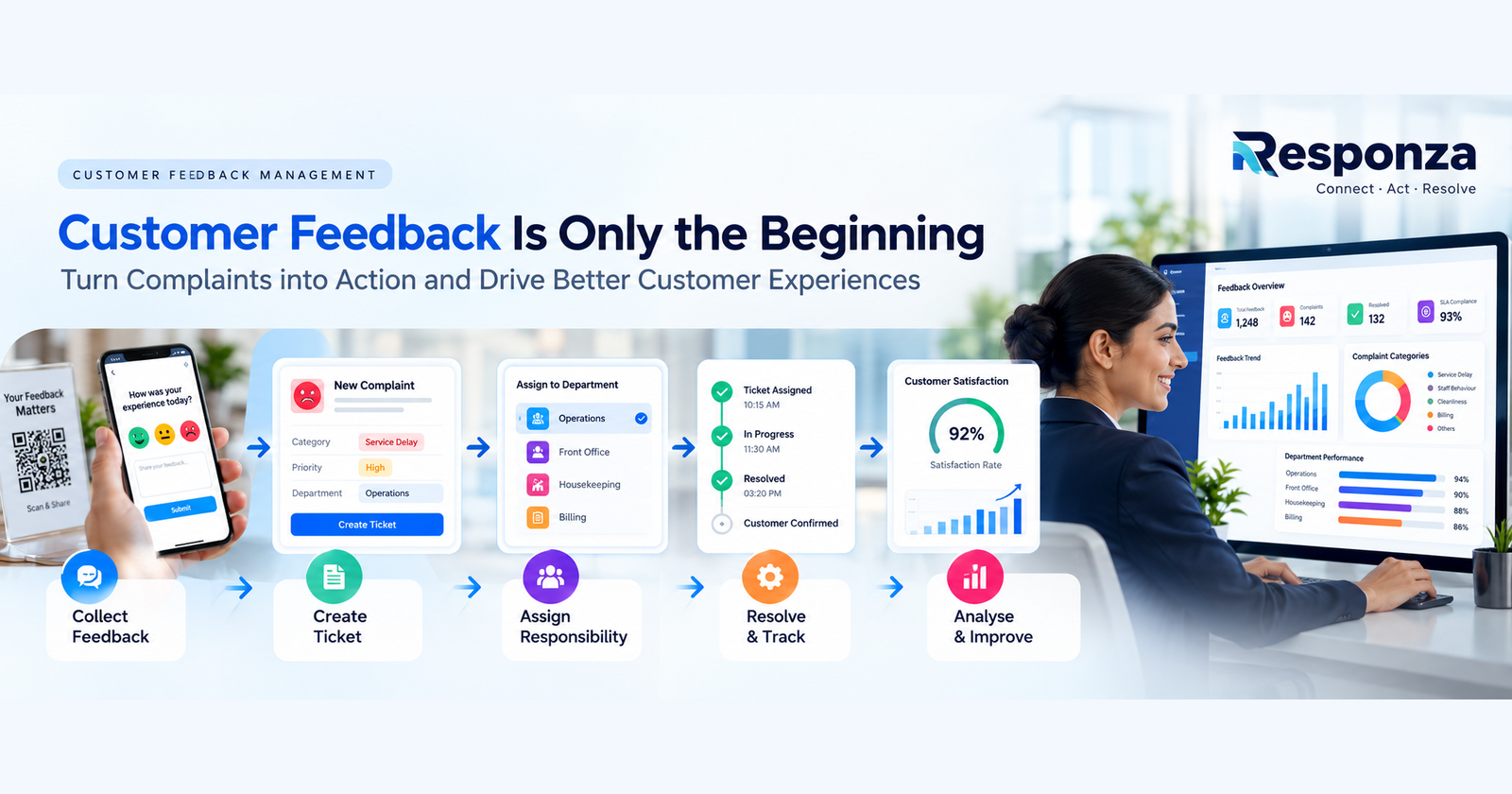
An effective feedback management process should connect three essential stages: collecting feedback, taking action, and confirming resolution.
Step 1: Collect feedback from every relevant touchpoint
Make it easy for customers to share their experiences.
Businesses can use QR codes at counters, hospital rooms, restaurant tables, hotel rooms, service desks, or retail billing counters. Feedback links can also be shared after a purchase, service visit, appointment, or customer interaction.
The objective is to capture customer opinions at the right moment, while the experience is still fresh.
Step 2: Convert complaints into trackable tickets
A complaint should not remain just a low rating or a comment in a report.
It should become an actionable task with a unique reference, a responsible department, a priority, and a defined resolution timeline.
For example, a hospital patient reporting a billing delay can have the complaint routed to the billing department, while a housekeeping issue can be assigned to the appropriate facility team.
This creates a clear process for handling each concern.
Step 3: Assign ownership and monitor deadlines
Every complaint needs someone responsible for resolving it.
Service-level agreements (SLAs) help businesses define expected response and resolution timelines based on complaint priority. Automated reminders and escalation rules can alert department heads or management when a deadline is approaching or has been breached.
This reduces the risk of complaints remaining unattended.
Step 4: Identify the root cause and prevent recurrence
Resolving an individual complaint is important, but preventing the same issue from happening again is equally valuable.
Root Cause Analysis (RCA) helps teams identify why a problem occurred. Corrective and Preventive Actions (CAPA) help document the immediate fix and the steps required to prevent recurrence.
For example, repeated complaints about long waiting times may reveal insufficient staffing during peak hours. The solution may involve adjusting staff schedules rather than simply apologising to each affected customer.
Step 5: Confirm resolution and measure satisfaction
Closing a ticket should not automatically mean that the customer is satisfied.
Where appropriate, businesses should confirm whether the issue has been resolved to the customer's satisfaction. Unresolved concerns can be reopened or raised again, with the previous history available for review.
This creates a continuous improvement cycle rather than a one-time complaint-handling exercise.
3. Why SLA Tracking and Escalation Matter
When complaints are handled manually, managers often discover delays only after a customer follows up or escalates the issue.
SLA tracking introduces a more proactive approach.
Businesses can define timelines according to urgency, assign tickets to the appropriate teams, monitor pending cases, and establish escalation paths for overdue or at-risk complaints.
Management can then answer important operational questions:
-
How many complaints are currently open?
-
Which complaints are approaching their deadlines?
-
Which departments have the highest number of overdue tickets?
-
How quickly are teams resolving customer issues?
-
Are certain complaint categories repeatedly missing their SLAs?
These insights help managers move from reactive complaint handling to structured service management.
4. Use Customer Feedback Analytics to Improve Business Performance
Customer feedback becomes significantly more valuable when it is analysed over time.
A centralised dashboard can help management identify trends across departments, branches, service categories, and complaint types.
Important metrics to monitor include:
Customer satisfaction: Understand how customers rate their experiences and how those ratings change over time.
Net Promoter Score (NPS): Measure customer willingness to recommend your business and track the balance between promoters, passives, and detractors.
Resolution time: Understand how long it takes teams to address and close complaints.
SLA compliance: Measure the proportion of tickets resolved within their defined timelines.
Recurring complaint categories: Identify common issues such as waiting times, billing delays, product quality, staff behaviour, or service delays.
Closure satisfaction: Evaluate whether customers are satisfied with the outcome, rather than measuring closure alone.
When reviewed regularly, these metrics can support better decisions about staffing, processes, training, service standards, and quality improvement initiatives.
5. Customer Feedback Management Across Different Industries
A structured feedback and resolution process can benefit almost any organisation that serves customers or manages internal service requests.
Hospitals and healthcare
Capture patient feedback across OPD, IPD, billing, nursing, housekeeping, and other departments. Route complaints to the appropriate teams, monitor resolution timelines, and maintain documented corrective actions.
Hotels and hospitality
Use QR-based feedback to capture guest concerns about housekeeping, food, room service, and facilities. Address issues during the guest's stay wherever possible.
Retail and showrooms
Track feedback about staff interactions, billing, product availability, and after-sales service. Compare customer experience across branches and identify recurring issues.
Education institutions
Manage parent and student feedback, campus facility complaints, administrative concerns, and grievance resolution through a defined workflow.
Manufacturing and B2B businesses
Capture dealer and distributor feedback, product quality complaints, delivery concerns, and service issues. Track corrective actions and maintain visibility into recurring product or process problems.
The key is to configure the workflow around the organisation's departments, responsibilities, priorities, and service standards.
6. How Responza Helps Businesses Close the Feedback Loop
Responza is a cloud-based Feedback & Resolution Management Platform designed to help businesses connect customer feedback with accountable action.
Instead of treating feedback collection and complaint resolution as separate activities, Responza brings them into a structured workflow.
With Responza, businesses can:
-
Collect feedback: Create branded feedback forms and share them through QR codes, links, and supported channels.
-
Automate ticket creation: Convert complaints and low ratings into actionable tickets.
-
Assign responsibility: Route issues to the appropriate departments and track ownership.
-
Monitor SLAs: Set resolution timelines, receive alerts, and escalate overdue cases.
-
Document corrective action: Record root causes, corrective actions, and preventive measures.
-
Measure performance: View dashboards and reports covering feedback trends, NPS, department performance, SLA compliance, and resolution outcomes.
-
Manage multiple locations: Monitor branches and departments with role-based access and consolidated reporting.
By bringing these processes together, Responza helps organisations establish a more transparent, measurable, and consistent approach to customer feedback management.
7. From Complaint Management to Continuous Improvement
Customer complaints are not merely problems to be closed. They can reveal weaknesses in processes, communication, staffing, product quality, and service delivery.
Businesses that analyse these signals systematically can use them to improve their operations and customer experience.
The goal is not simply to reduce the number of complaints. It is to understand why they happen, resolve them effectively, and prevent avoidable problems from recurring.
That requires a process where every relevant concern is captured, assigned, tracked, resolved, and reviewed.
Listen to your customers. Take ownership. Resolve the issue. Learn from the outcome.
That is how feedback becomes a driver of continuous improvement.
Ready to Turn Customer Feedback into Action?
Discover how Responza can help your organisation streamline feedback collection, automate complaint tracking, improve departmental accountability, and gain visibility into customer satisfaction.
Connect. Act. Resolve.
Visit www.responza.co.in to explore Responza or book a personalised demo for your business.